
BP7 Performance Insights – Part 1: Stable Performance Needs Feedback
How Closed-Loop Control Unlocks the Full Potential of the Bartels Pump | BP7
Stable Performance with Sensor Feedback
This is how stable and accurate the Bartels Pump | BP7 performs in both liquid and gas application:

During closed-loop PID control operation with a target flowrate of 500 µl/min, the BP7 micropump runs at a fixed frequency of 200 Hz while its voltage varies in response to real-time feedback from a flow sensor. This adaptive adjustment keeps the flowrate stable and accurate for over 300 minutes, effectively compensating for any fluctuations in the system.
One parameter remains constant (frequency), while the other (voltage) is dynamically adjusted. This is visible as a slight upward trend in the voltage curve, reflecting how the system compensates for changes over time.
What is Closed-Loop Control?
In open-loop setups, the BP7 operates based solely on predefined parameters: voltage, frequency, and signal shape. However, small changes in environmental conditions, media viscosity, or backpressure can still lead to drift or inconsistency over time.
Closed-loop control, by contrast, introduces a feedback mechanism:
- A sensor (e.g. flow or pressure) continuously monitors system output.
- The sensor data is sent to a controller, which compares it to a target value.
- The controller dynamically adjusts the pump’s actuation parameters to minimize the difference between actual and desired output.
This approach improves accuracy, stability, and system resilience to disturbances, making it ideal for regulated dosing, reaction control, or long-duration experiments.
When paired with closed-loop control, the BP7 micropump can maintain a guaranteed level of stability depending on the feedback over time and even under fluctuating system conditions.
Key Benefits
- Stability over time, even with fluctuating ambient conditions
- Automatic compensation for aging effects or minor system leaks
- Improved reproducibility between runs or between pumps
System Architecture and Working Principle of a Closed Loop Control System
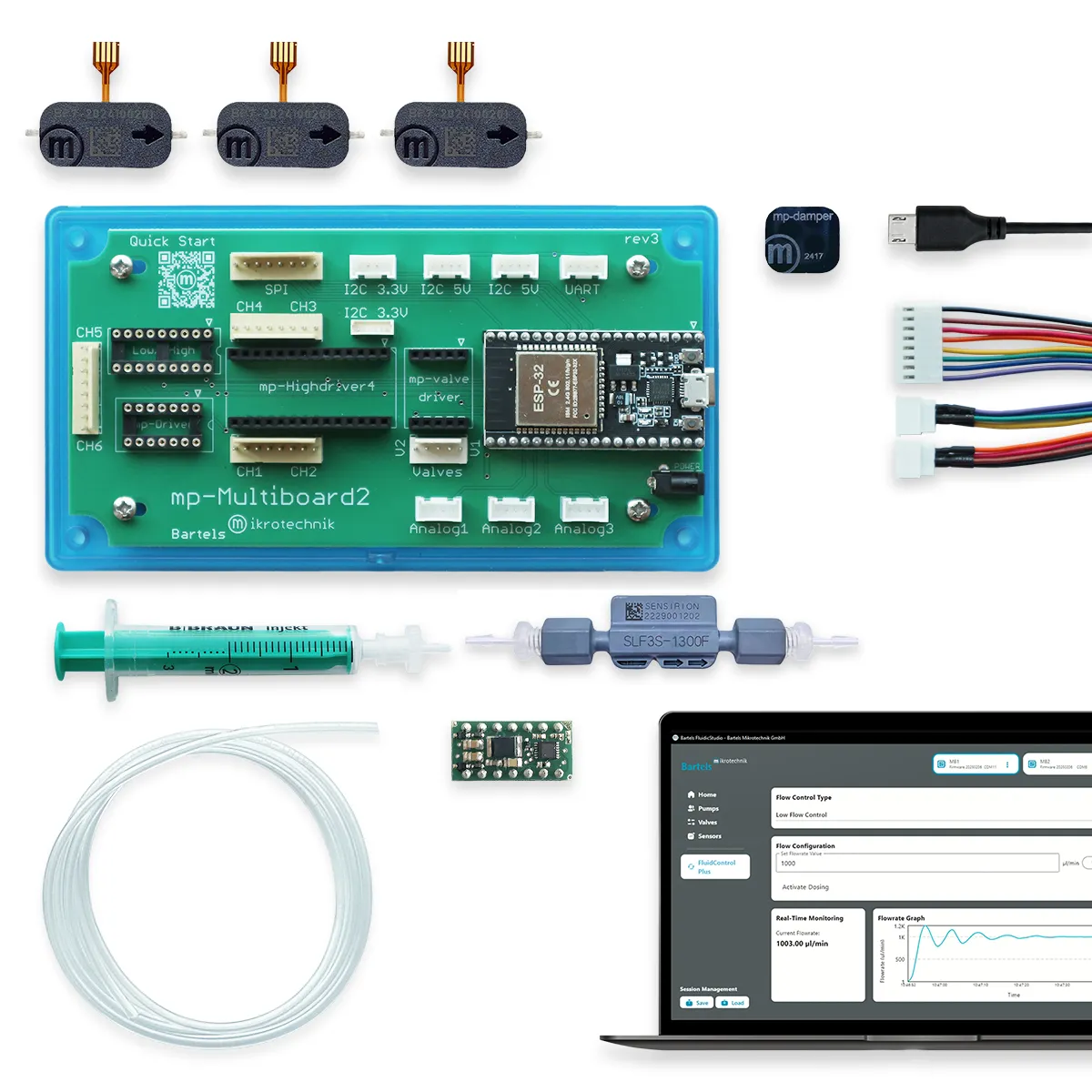
A typical closed-loop control setup includes:
- The Bartels Pump | BP7 micropump
- Flow sensor (e.g. thermal, MEMS, etc.) or pressure sensor (placed in critical chamber or tubing section)
- Pulsation damper (for more accurate sensor readings)
- Controller or signal processor (custom microcontroller, PC with control software, or integrated electronics)
- Software logic: PID, threshold-based, pressure-triggered or stepwise adjustment

The block diagram highlights the feedback loop between pump, sensor, and controller.
How It Works
- The user sets a target flowrate/pressure value.
- The controller reads live data from the sensor.
- If the measured value is below target, the controller increases frequency or amplitude.
- If the measured value is above target, the controller reduces the driving signal.
- This cycle runs continuously, compensating for any changes in fluid properties or system resistance.
Flowrate Control with the BP7
One of the most common and impactful use cases for closed-loop control is maintaining a stable flowrate, especially in systems sensitive to fluctuations due to viscosity, pressure changes, or long-term drift.

Fluidic Schematic of a flowrate control system using a micropump, a damper and a sensor
Pressure Control with the BP7
In some applications, like microreactors, membrane perfusion, or droplet generation, it’s more useful to regulate pressure than flowrate. The BP7 can be integrated into pressure-controlled systems using a pressure sensor and similar control logic.

Example schematic of closed-loop pressure control with inline pressure sensor
With a pressure sensor in place, the closed-loop system can reliably stabilize pressure throughout operation by adjusting the pump’s actuation continuously in real time.
Pressure Stabilization in a Microchannel Setup
Consistent performance after system start up in both liquid and gas applications:

Pressure over time with closed-loop control maintaining the target pressure. The graph shows how the system stabilizes after startup: While the pressure curve quickly converges to the target value, the frequency (used as the regulating parameter) initially rises sharply and then levels off as the system settles. Voltage remains constant throughout, serving as a fixed baseline parameter.
Considerations for Pressure Control
- Backpressure must be taken into account, especially in complex channels or when valves open/close dynamically.
- The sensor location has a major impact: placing it close to the target control region is key.
- Flowrate may fluctuate as pressure is prioritized, so this is often a trade-off configuration.
Summary of Closed-Loop Control
Closed-loop control elevates the BP7 from a standalone micropump to a fully adaptive component, capable of meeting demanding requirements in dynamic fluidic systems.
| Control Type | Sensor Used | Application Focus | Key Benefit |
| Flowrate Control | Flow sensor | Reagent dosing, perfusion | Maintains consistent volume delivery |
| Pressure Control | Pressure sensor | Microreactors, sealing | Stabilizes pressure-sensitive processes |
What’s next?
Now that you know how closed-loop control works and how it enables stable, adaptive flow and pressure control with the BP7 micropump it’s time to look at how we actually test that performance in real-world conditions.
In BP7 Performance Insights – Part 2: Detailed Performance Specification of this series, we walk you through our test procedures for liquids and gases and explain how we derive key performance specs like dynamic range, mean values, standard deviation, and 2-sigma ranges.
Continue to BP7 Performance Insights – Part 2: Detailed Performance Specification